
From Parsifal to Macunaíma: Recognising Brazilian Identity
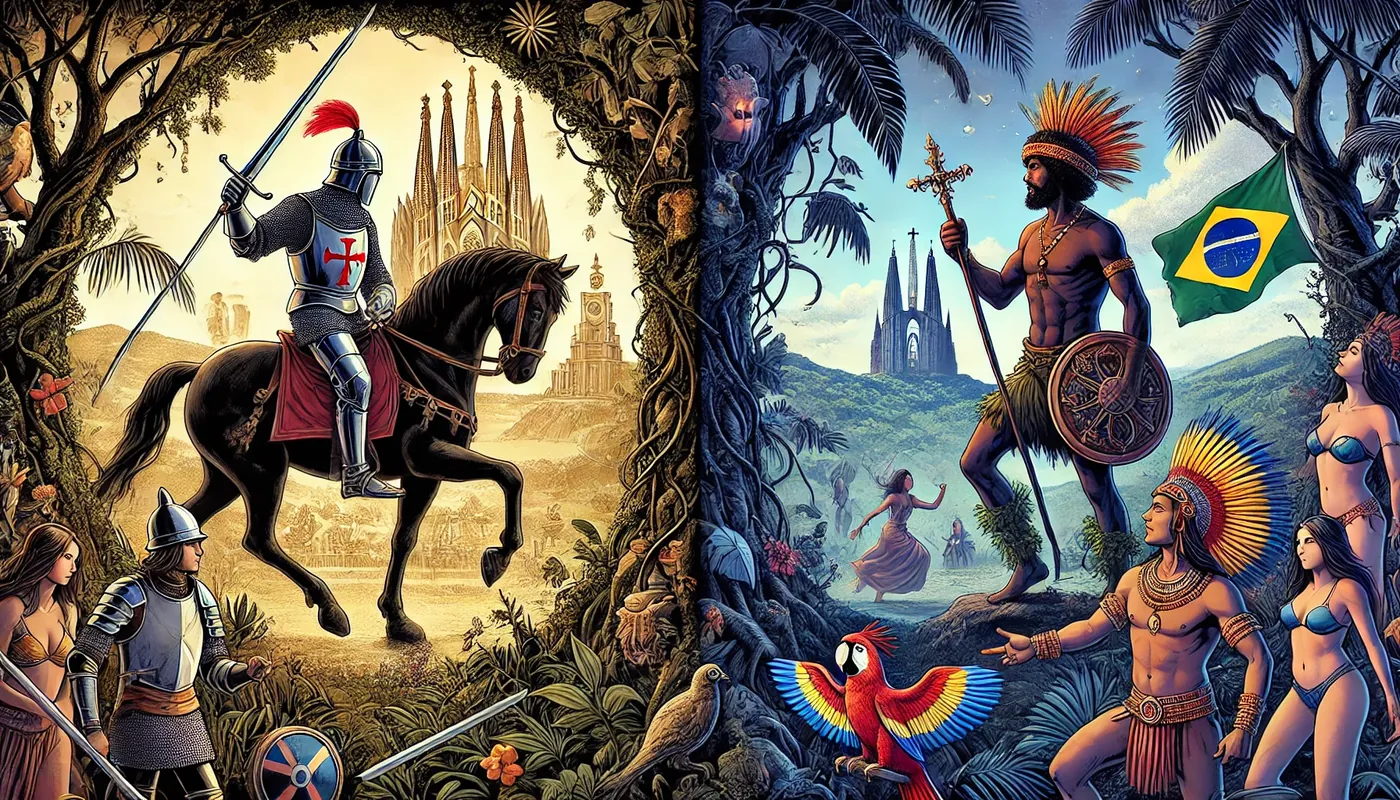
On Ash Wednesday itself, I decided to go deeper into the hero’s journey. I had always grounded myself in European themes, since all of Jung’s theory was built on the narratives of his own people; he draws many examples from both the Christian and the Nordic/Germanic traditions (Wotan) and tries to link them in order to understand his time and the difficulties of integration arising from the cultural clashes of that era in Europe. As the Brazilian Carnival brings so much richness and so much controversy to the surface, I decided to devote myself to this subject, looking for paths of integration through Brazilian literature, seeking to respect and honour our people, our historical formation and our ancestors.
A people’s identity is shaped by its narratives, myths and models of heroism. For centuries the West relied on the archetype of the knight, represented by the myth of Parsifal and his quest for the Grail. This model of heroic masculinity, built on overcoming trials and repressing desire, has deeply influenced the way men are socialised. In Brazil, however, a hero of another nature emerged from the hands of the writer Mário de Andrade: Macunaíma, the “hero with no character”, who breaks with this tradition inherited from Europe and points towards a fluid, mixed and essentially Brazilian identity.
The Knight and the Anti-Hero of the Americas: Two Ways of Being a Man
Parsifal embodies the classic European hero, whose journey is based on overcoming his naïvety in order to reach maturity. He starts from a state of childlike innocence, breaks with the maternal feminine and seeks fulfilment through a spiritual and moral quest. The idealisation of the feminine is central to the Grail myth: woman appears as muse or tester, and may be saint (Blanchefleur) or profane (the Loathly Damsel), but never fully integrated with the masculine.
The Grail itself is a symbol representing the divine feminine principle, the vessel of mystery, but also the masculine quest for spiritual illumination. The Fisher King’s wound is another crucial element: he was wounded in the thigh, near the genitals, which symbolises a castrated masculinity, unable to generate life and prosperity. This wound can only be healed when Parsifal asks the right question: “Whom does the Grail serve?”. This detail reinforces the idea that the masculine journey is not only one of domination or courage, but of understanding and integrating the feminine and the mystery of life, and also of serving something greater: a kingdom, others beyond one’s own ego.
Macunaíma, on the other hand, does not follow this linear development. He moves between child and adult, between cunning and naïvety, without any need, or even concern, to master his instincts. Unlike the European knight, he neither idealises women nor represses them. On his journey, feminine figures appear as part of life, without the duality of sacred and profane. Macunaíma lives the principle of Eros directly, without guilt, without a transcendent goal. His heroism lies not in discipline and overcoming, but in fluidity, in the capacity to adapt and reinvent himself.
Another central symbol in Macunaíma is the muiraquitã stone, the amulet representing the hero’s connection with his love and his identity. When he loses the stone, Macunaíma also loses part of himself and sets off on a journey to recover it. But the great difference is that this journey does not end as Parsifal’s does: Macunaíma finds no deep meaning or spiritual redemption; his quest is marked by improvisation, comedy and the absurd. In the end, his identity dissolves, just as Brazilian identity always seems to be in constant reinvention.
Cultural Clash and the Repression of Eros
The opposition between these two models reflects the very encounter between European culture and Brazilian identity. The West, especially through Christianity and the rationalist tradition, created a strong separation between body and spirit, between desire and virtue. This view led to the repression of Eros, the energy of life, creativity and pleasure. While Christianity emphasised guilt and the control of desire, many European pagan traditions had fertility rituals and celebrations that integrated body and transcendence, but these were suppressed over the course of Christianisation. I believe we still have much to learn from them.
In Brazil’s Afro-Indigenous religions, such as Candomblé and Shamanism, there is a more integrated approach, in which spirituality and pleasure are not seen as opposites, but as parts of human experience. Trance, dance and rituals are ways of connecting with the sacred that involve body, sound and movement, in contrast to the European tradition of introspection and withdrawal from the sensory world. In the United States, for example, this repression gave rise to a cult of war, consumption and violence as ways of channelling forbidden desire and repressing our instincts.
For the authors of the book And They Knew Each Other: The End of Sexual Violence, unbounded aggression and sexuality are forces to be managed, not repressed. These forces are also faces of Eros that were banished and demonised, and which, in the name of truth and love, must finally be accepted and affirmed. Happiness and misery also depend to some extent on how we can find a positive attitude towards our inner impulses; as long as the wild side of Eros is repressed, it will keep burning in our unconscious and lead to eruptions of uncontrollable impulses. (Which is, in the authors’ view, the root of fascism.)
Art, in all these traditions, also becomes an essential means of expressing what Western reason so often represses. Carl Jung saw art as a manifestation of the collective unconscious, a way of giving form to archetypes and integrating deep psychic contents. In Brazil, popular art forms such as capoeira, maracatu and Candomblé carry this fusion of body and spirit, allowing a symbolic experience that goes beyond the dichotomy between rational and emotional. Macunaíma, as a narrative, is an example of this hybrid art, mixing orality, improvisation and mythical elements, and creating a new space in which Brazilian identity can show itself.
In Brazil, the Indigenous and African cultural heritage kept alive a more integrated relationship between body and spirit. Macunaíma symbolises this integration: his laziness is also a resistance to the European productivist rhythm; his sensuality is not seen as sin, but as part of living. Throughout history, however, Brazil has tried to mould itself to the European and North American model, repressing this fluid, celebratory identity in favour of a disciplined and aggressive masculinity.
Recovering Macunaíma and a New Brazilian Masculinity
If recovering Macunaíma means recovering Eros, the challenge is to find a balance. How can we bring back this fluidity without falling into the caricature of superficial trickery? How can we value pleasure without it turning into reckless hedonism? The answer may lie in building a masculinity that accepts:
- Pleasure as a Legitimate Element: Working on men’s relationship with their own body and desire, without guilt or compulsion, understanding that pleasure is not an enemy of spirituality but a portal to deeper states of connection with oneself and with the world. Ancestral cultures always understood that physical and emotional ecstasy can be a way into the sacred, something the West repressed in its pursuit of asceticism.
- The Feminine as Part of the Journey: Leaving behind the dichotomy between the idealised woman and the rejected woman, learning to live with the inner and outer feminine without the need for control.
- Creativity as a Path: Recovering the playful, improvising spirit, bringing forms of expression that are not only productivity or competition.
- The Integration of Body and Spirit: Bringing back dance, music, orality and ritual as ways of experiencing the sacred, without the need for repression.
- Art as a Tool for Integration: Following Jung’s vision, encouraging art as a way of accessing the collective unconscious and symbolically expressing the repressed energies of the male psyche.
Conclusion
Brazil has the opportunity to build a model of heroism that is not grounded in war, in the overcoming of desire or in the idealisation of the feminine. Instead of simply trying to fit European and/or North American standards, it is possible to create a path of our own, where Macunaíma is not just a failure but the symbol of the reinvention required of a Brazilian who has always been pressed by a melting pot of cultures. Perhaps then we can see Brazilian masculinity the way we see our country: somewhat exotic, different, creative, welcoming and persistent. We are not perfect, and precisely because we do not aim for perfection, we somehow manage to embrace our differences through this outlook and these attitudes, which may seem rather childlike from a Eurocentric point of view.
I personally believe that our people did not kill our childlike spirit, nor enslave or repress its soul as so many other peoples did. We have managed to preserve a certain innocence that we need in order to open ourselves. Our struggle and our pride as a people who fought against literal slavery are an important trait that keeps us from clinging to fixed ideas and ideals that could enslave our subjectivity and fix the way we see ourselves as a people or as a gender. Brazilians carry in their way of being their own art of living, very different from any other people, and yet one that embraces them all.
Newsletter
Essays by email
New essays on Jungian psychology, masculinity, myth and the body, sent to your inbox. Most are written in Portuguese, with some in English.
Free, via Substack. Unsubscribe at any time. Privacy policy.