
Between the Mountain and the Father: the Appeal of the Contemporary Sacred Masculine
I am a curious explorer of the masculine universe; it has been the central theme of my life for the past four years. After a time of stumbling along, I gradually moved away from the dichotomy of masculine and feminine. There were many unconscious conditionings, many identifications with narratives and moulds predetermined by family and culture that hemmed me in. I went deeper, explored, learned and broadened, and little by little it stopped being a pain. Now I can perceive its subtler movements, observing it as a phenomenon, with some distance, yet at the same time feeling the gravitational pull it exerts on my soul.
In general this is the proposal of Jungian psychology, and it is my proposal in the following analysis of the self-styled “Legendários” movement.
The Legendários movement and its context
In recent months, the Legendários group has drawn media attention by attracting celebrities and wide publicity. It is a Christian men’s organisation that runs outdoor retreats, four-day immersions in the mountains without comfort, using warlike terms (“games”, “mission”, “warriors”), songs of exaltation and initiation rituals. According to a CNN Brasil report, the vice-president of Legendários himself states that “Legendário 001” is Jesus Christ, and that the purpose is to lead men to “face challenges” in order to increase their emotional, physical and spiritual resilience. The group already counts thousands of members in Brazil (more than 41,000 men), and up to 30% of registrations are made by the men’s own wives. The official discourse preaches a “reunion with faith and the masculine essence”, but critics point out that the movement shows traits of modern cults. In this analysis we will discuss the Legendários phenomenon critically from several theoretical perspectives (psychological, historical and sociological), highlighting both its contemporary appeal and its underlying risks.
Its appeal to contemporary men
A central question is why so many men today feel drawn to Legendários. From a psychological point of view, Jung had already observed that modern man increasingly feels a lack of support in the traditional religious confessions. In complex, urbanised societies, many men report insecurity about their role and feel disconnected from cultural models of masculinity. Legendários promises to fill this gap by offering meaning (“mission”), belonging and social recognition in an environment of male camaraderie. The proposal is especially seductive to men used to mantras of strength, competition and productivity, usually middle-class and between 30 and 50, who are living through the crisis of traditional masculinity. In short, the movement exploits the desire to recover an idealised image of the “original man”, crushed by modern pressures (political correctness, the “feminisation” of the world, and so on).
In other words, it works as an “emotional GPS” for those who feel lost: it offers epic narratives and extreme physical activities as a script for masculine self-affirmation.
Militarised symbolism, nature and ritual
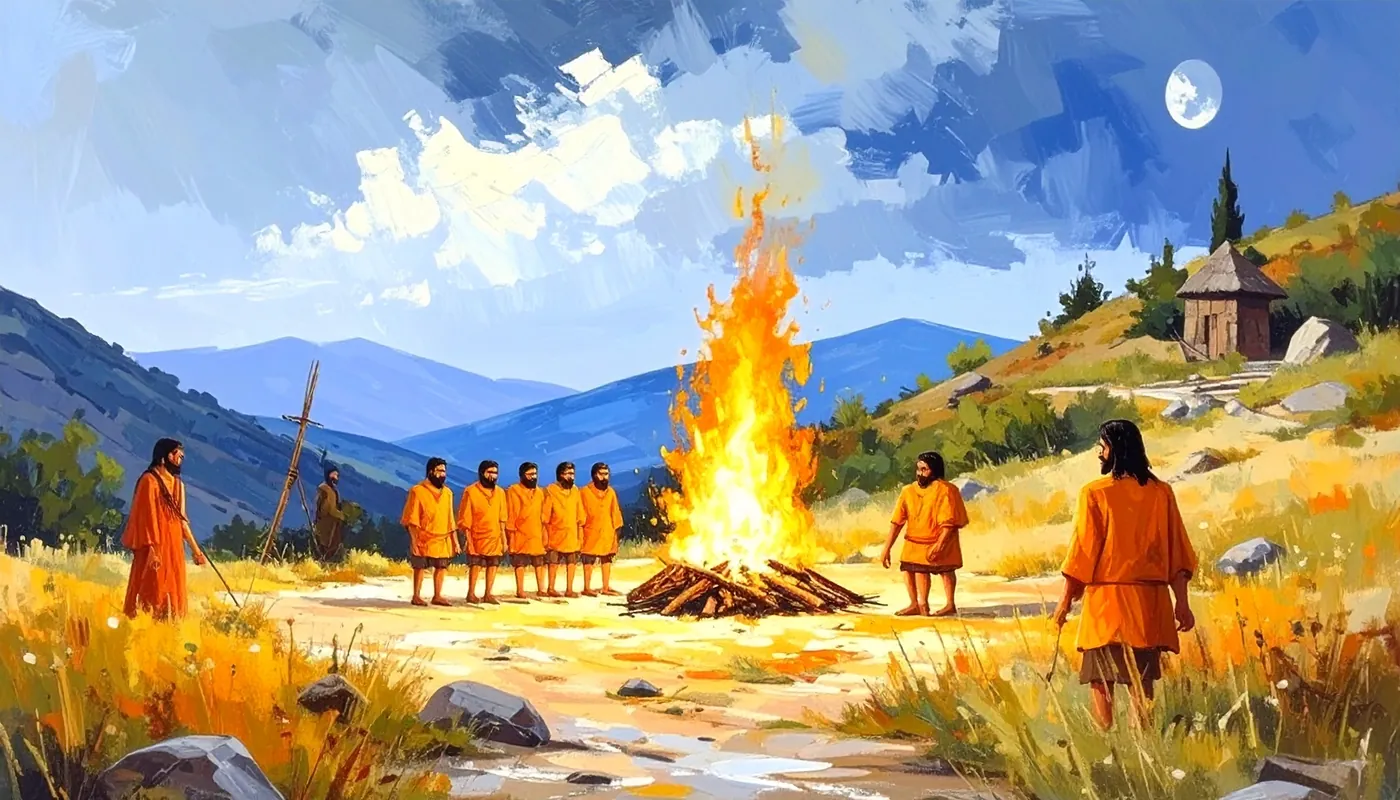
Legendários makes broad use of language and symbols associated with militarism and adventure in nature. This includes war cries, uniforms (orange T-shirts), tribal connection (“unity”, “camaraderie”) and overcoming physical trials. Such symbolism evokes the archetypal image of the warrior, associated with men in heroic narratives for at least five thousand years: the heroic man who proves his worth in combat or on an expedition. In analytical psychology, Jung noted that ancient cultures created rites of passage for young men, separating them from the mother and turning them into a kind of spirit through a new birth. This ritualised transition is not only social or cultural; it mirrors a deep psychic process of inner transformation, in which the individual is confronted with the symbolic death of his childhood identity in order to be reborn in a new form.
Jung observes that these processes follow a symbolic logic that appears universally in the form of myths and rituals. He links this symbolic structure to the image of the Trinity, understood not only as a theological dogma but as a psychic archetype representing distinct phases of inner maturation:
“As a psychological symbol, the Trinity signifies, first, the homoousia or essence of a process that unfolds in three stages, which we may regard as phases of an unconscious maturation within the individual. (…) Myths and rites, as the medicine of ancient Egypt shows us, for example, have a psychotherapeutic meaning, even in our own day.” JUNG
*Homoousion is a concept of Christian theology concerning the identity of the persons of the Holy Trinity. This Christological concept was introduced into the profession of faith by the First Council of Nicaea and refers to the divinity of Christ, as being of the same substance as the Father.
Rites of passage, then, especially military or tribal ones involving physical endurance, separation from the mother’s world and entry into the male collective, can be understood as symbolic expressions of these three stages of maturation: separation, transition and reintegration, parallel to the psychic birth, death and rebirth of the ego on its way towards the Self.
Thus the rituals of Legendários, days away from the urban world under austere conditions, can work as a modern version of tribal initiation, signalling (ritually) the “redemption” or renewal of the man. These moments reinforce the idea of an exclusive cell (men only, isolation), which strengthens the bond of the group.
The intense use of nature (mountains, cold, fire) also has symbolic meaning. It evokes the idea of returning to one’s roots, purifying oneself far from the “civilisation of comfort” and reconnecting with a wild, deep strength. In many myths and rituals, the return to the wild, to the forest or the mountain, symbolises inner transformation. The militarised and sadistic aspect (challenging the body) also suggests endurance training: in the movement’s jargon, one confronts “fear” and “weakness”. This appeal to self-imposed brutality can work psychologically as a discharge of accumulated tension or as a projection of the confrontation with the “inner enemy”. In Jungian studies, the figure of the “suffering hero” (Christ, Shiva, Prometheus, Odin, etc.) reiterates that the initiative of sacrifice is a path of affirmation of the Self (e.g. Christ as a model of archetypal wholeness).
The problem arises if, in this setting, legitimate emotions (fear, fragility) are only accepted as something “to be overcome”, in the name of a self-imposed fortitude. Indeed, according to Felipe Guimarães, in Legendários “man is seen as warrior, provider, leader. Emotions are accepted, but only if channelled into overcoming. Vulnerability? Only in the service of strength.” Such a dichotomy reinforces a militarised view of the inner world: crying in public is “fine, but get up, brother”; feeling only exists if it is quickly turned into action.
Christian structure and the absence of the feminine
The Legendários proposal is openly Christian, with Jesus Christ as its supreme inspiration (“Legendário 001”). This carries a weight of religious symbolism. However, this masculine emphasis around the figure of Christ implies a classic patriarchal structure, as history and anthropology show us. According to Gerda Lerner, patriarchy was established very early on, based on the “commodification of women” as the foundation of private property and on the systematic exclusion of the feminine from the public sphere. In the Legendários group we can see a modern repetition of this pattern: glory is given to the man (Christ, his figure as hero), while women remain at the margins. Jung stresses that in many archaic religions the male cults forbade even the presence of women in the sacred mysteries; young men were separated from their mothers in initiation rites, a process that continues to this day in priestly celibacy. This pattern shows that the movement reinforces patriarchal values: there is (officially) room only for the masculine side of God (the Father, the Son), with no feminine counterpart.
This exclusion of the feminine, and the dominance of strength and reason above all, carries psychological risks. Jung warned that religion cannot serve as an excuse to do without the image of woman [anima], because this image is necessary. The anima represents the feminine unconscious in a man, a source of intuition, empathy and emotional integration. The movement’s doctrine suggests a man raised to the extreme, admitting no weakness, which creates an inner imbalance in many: it is normal for a man to resist his anima, since she represents the unconscious with all the contents excluded from conscious life. When this aspect (feeling, care, receptivity) is repressed, a disjointed psychic state can arise, marked by inner conflict and even sublimated violence. In symbolic terms, a one-dimensional religious fixation (Christ alone as the “model”) resembles the Jungian idea of an “I” that refuses its necessary opposite, creating a radical dualism (good versus evil) with no middle ground, a danger highlighted in Aion. Moreover, this focus prevents dialogue with qualities traditionally considered “feminine” (compassion, listening, nurture), reinforcing old hierarchies that Lerner defined as systems of domination.
“The more unconsciously the religious problem is posed, the greater the danger that man will misuse the divine core within him for a ridiculous or demonic inflation of his own person, instead of realising that he is no more than the stable in which the Lord is born. Even on the highest summit we shall never be beyond Good and Evil, and the more we know of the complicated entanglement of Good and Evil, the more uncertain and confused our moral judgement will become.” JUNG
Marital dynamics and the wives’ participation
CNN Brasil’s observation that 30% of participants were signed up by their wives reveals a great deal about marital dynamics in this context. At first, this may indicate a feminine investment in the partner’s “redemption”, as if the salvation of the family depended on the man’s transformation. One possible reading, in the light of Lerner, is that women have traditionally seen their “status” as tied to their husbands: “respectable women are those attached to a man”. The husband’s success or sanctification thus turns into domestic and material prestige for them. In psychological terms, this is a projection: wives project onto their husbands the task of fulfilling ideals (of faith, virility, leadership), perhaps because their own voices and desires are ignored. It is not that they act with conscious malice, but it reflects the role socially assigned to women: to support the man and, in the process, expect emotional and social security in return. This configuration also hides the repression of women’s feelings: by setting aside their own claims in order to “push” the husband onto a path of transformation, they reinforce the patriarchal dynamic in which intimate feeling and inner (feminine) conflict remain without open expression. Jung would have interpreted this as a game of mutual projections in marriage: each spouse unconsciously lives out parts of the other’s unconscious, blocking the psychic development of both. In short, the wives’ involvement in Legendários suggests that they place in the masculine project the expectation of a solution to family tensions, something symptomatic of one-sided marital structures.
Cult-like aspects and symbolic mechanisms
Several analysts have raised the suspicion that Legendários is closer to a sect or cult than to a mere religious fraternity. The atmosphere of the gatherings shows traits common to sectarian movements: a charismatic leader, collective emotional appeals, a rigid moral doctrine, initiation rituals and the promise of total transformation. As one editorial piece describes it, they “build an almost religious structure. There are initiation rituals, war cries, leaders revered as prophets and a moralising discourse that borders on fundamentalism. The promise is not only of individual change, but of salvation” (Felipe Guimarães). This shows the use of symbols and practices to create a closed group identity. The “Legendário” man is exalted as a superior category (“you were born to be a LEGENDÁRIO!”), and the motto of “salvation” lends an apocalyptic or millenarian sense to the undertaking. The manipulation of symbols (emotional preaching, liturgies of fellowship, salutes) amounts practically to a ritualisation of the unconscious.
Furthermore, the movement’s logic exploits modern mechanisms of socio-technical power. We live in the age of surveillance capitalism described by Zuboff: digital platforms collect behavioural data in order to persuade and shape behaviour. Although Legendários does not seem to use cutting-edge technology openly, it benefits from exposure on social media (influencers promoting the event) and from the “behavioural futures markets” Zuboff mentions; after all, every man who signs up consumes and generates emotional data (stories of overcoming, inspiring videos, etc.) and is the target of persuasive discourse. The concept of instrumentarian power explains how the experiences offered (and even Legendários’ marketing campaigns) are designed to know and shape human behaviour towards others’ ends. In other words, the promise of personal growth ends up also serving organisational interests: gaining followers, funds and prestige, and controlling narratives.
Through a symbolic lens, we can see that Legendários mobilises powerful archetypes, the warrior, the saviour, the father, to the extreme, mediating between the sacred and the profane. The risk is the creation of a closed internal “symbolic reality”, in which outside questions (about feminism, personal doubts or plurality of beliefs) are seen as betrayal. In this framework, anyone who doubts or leaves the group is labelled weak or worldly, reinforcing internal cohesion. In psychology, this kind of mechanism resembles an extended projection: the movement strengthens itself by demonising the “enemies of true masculinity” (whether critics, feminists or simply modernity), consolidating the collective identity. Although there is no physical attack or explicit doctrine of hatred (at least none documented), the inner symbolic tribunal, which imposes emotional censorship (“don’t cry too much, a man has to be strong”), already amounts to a form of psychic domination.
Paternal absence
Finally, among the countries with the largest numbers of members highlighted on the group’s own website, a similar pattern can be seen: a high rate of fatherless families, coexisting with traditionally patriarchal cultures. The absence of father figures in many homes (evidenced by numerous female-headed households) coincides with societies where machismo and rigid male hierarchies are the norm.
In this context, movements like Legendários offer “alternative models of masculinity”: rituals of physical ordeal and religious discourse that simulate a new father or male leader (as in the premise of “returning the hunter-hero to every family”, loslegendarios.org). The symbolic correlation is clear: young men lacking paternal references are drawn to groups that promise to recover traditional values of virility and divine purpose. In short, the combination of fatherless homes, or homes with an absent male model, a patriarchal tradition and a search for identity (religious or military) creates fertile ground for joining the Legendários movement in all these nations.
Conclusion
Legendários emerges in a context of crisis in male identity, using Christian narratives and intense rituals to promise the restoration of the “virtuous man”. Its appeal rests on exploiting emotional and existential needs, but its symbolic repertoire reveals potential traps. Psychoanalytic and historical reflections indicate that an exclusive emphasis on the masculine can repress necessary aspects of being (the feminine, ambivalence, suffering), replacing growth with a one-dimensional lifestyle cult. Caution is needed: beneath the varnish of empowerment and faith, movements like this can crystallise dogmatic and even abusive behaviour. Rather than attacking, we should understand that the desire to belong is legitimate, but it must be met in a balanced way. As Jung and Lerner suggest, overcoming the impasses of masculinity requires recognising the opposites within oneself (light and shadow, masculine and feminine) and opening up to mutual dialogue, not refusing them in the name of a one-sided salvation.
In a way, women and the sacred feminine hold a similar proposal operating on the other side of the coin: reinforcing a deep and in no way submissive feminine, a power meant to empower them, seeking to balance the scales, bringing values excluded by patriarchy to the surface, seeking a place in the wholeness of the human being, reviving feminine aspects of the divine, bringing the feminine out of the shadows, raising the trinity to a quaternity.
The idea of a quaternity of divine principles was fought with the greatest vehemence by the Church Fathers when, for instance, an attempt was made to add the essence of God as a fourth element to the three divine persons. This stubborn opposition is all the stranger when we know that the central symbol of Christianity, the Cross, is unmistakably a quaternity. JUNG
Movements like this, as well as men’s and women’s circles, can be valuable, and they are a response to the great individualism of our time, where loneliness cries out for belonging, for a place in the world, and where the instinctive fear of being adrift confronts us with the lack of protection that groups once offered us.
I personally believe in the transformative power of these movements, but with the idea that every guide or teacher must eventually be left behind and humanised. The “master” must be surpassed, and the son must become a father, freeing himself from rigid patterns of behaviour and accepting the wholeness of the human being, the aspects of both father and mother. Separation should be a means and not an end. The division between masculine and feminine serves as a tool for psychic understanding and rational discernment, so that they can be united in a psychic whole. Personal power comes precisely from the ego’s capacity to adapt and become flexible, freeing itself from patriarchal or matriarchal one-sidedness, becoming a bridge between the concrete world and the divine world, coming into contact with something beyond the self, beyond all identifications, beyond man and woman: a place where our deepest self connects with all of humanity without distinction, where we can truly find what unites us all.
Are you interested in men’s groups? Are you looking for a place where you can express yourself, reflect and seek a deeper understanding of what it means to be a man today? Join the waiting list for the Elemental Men’s Circle.
Sources
JUNG, Carl Gustav. Aion: Researches into the Phenomenology of the Self. (Collected Works, vol. 9/2). Portuguese edition: Petrópolis: Vozes, 2013.
JUNG, Carl Gustav. Psychology and Religion. (Collected Works, vol. 11). Portuguese edition: Petrópolis: Vozes, 2013.
JUNG, Carl Gustav. A Psychological Approach to the Dogma of the Trinity. (Collected Works, vol. 11). Portuguese edition: Petrópolis: Vozes, 2013.
LERNER, Gerda. The Creation of Patriarchy. Portuguese edition: São Paulo: Cultrix, 2019.
ZUBOFF, Shoshana. The Age of Surveillance Capitalism: The Fight for a Human Future at the New Frontier of Power. Portuguese edition: Rio de Janeiro: Intrínseca, 2020.
CNN BRASIL. Legendários: conheça o movimento que atrai nomes como Eliezer e Thiago Nigro. CNN Brasil, 30 Apr. 2024. Available at: cnnbrasil.com.br. Accessed: 2 May 2025.
GUIMARÃES, Felipe. Legendários: a seita dos alfa em crise e a nostalgia por uma masculinidade perdida. Medium. Available at: medium.com.
LEGENDÁRIOS. Official website. Available at: legendariosoficial.com.br. Accessed: 2 May 2025.
INSTAGRAM. Official Legendários profile; personal profiles of Eliezer (@eliezer) and Thiago Nigro (@thiago.nigro). Accessed: 2 May 2025.
WIKIPEDIA. Homoousion. Available at: en.wikipedia.org. Accessed: 6 May 2025.
YOUTUBE. Official Legendários channel. Available at: youtube.com/@legendariosoficial. Accessed: 2 May 2025.
ALVES, Jorge A.; CAVENAGHI, Suzana M. Famílias monoparentais no Brasil: aspectos sociodemográficos e desafios contemporâneos. Revista Brasileira de Estudos de População, v. 39, p. 1–25, 2022. Available at: rebep.org.br. Accessed: 6 May 2025.
CELADE / CEPAL. América Latina: hogares con jefatura femenina. Santiago: CEPAL, 2015. Available at: cepal.org. Accessed: 6 May 2025.
INEC (Costa Rica). Encuesta Nacional de Hogares 2024. San José: INEC, 2024. Available at: inec.cr. Accessed: 6 May 2025.
INEGI (Mexico). Mujeres y Hombres en México 2023. Mexico City: INEGI, 2023. Available at: inegi.org.mx. Accessed: 6 May 2025.
OECD. Children in single-parent households (indicator). Paris: OECD, 2019. Available at: data.oecd.org. Accessed: 6 May 2025.
UNDP. Human Development Report 2020: The Next Frontier. New York: UNDP, 2020. Available at: hdr.undp.org. Accessed: 6 May 2025.
UNICEF. The State of the World’s Children 2021: On My Mind – Promoting, protecting and caring for children’s mental health. New York: UNICEF, 2021. Available at: unicef.org. Accessed: 6 May 2025.
U.S. CENSUS BUREAU. Living Arrangements of Children Under 18 Years Old: 1960 to Present. Washington, DC, 2020. Available at: census.gov. Accessed: 6 May 2025.
Newsletter
Essays by email
New essays on Jungian psychology, masculinity, myth and the body, sent to your inbox. Most are written in Portuguese, with some in English.
Free, via Substack. Unsubscribe at any time. Privacy policy.